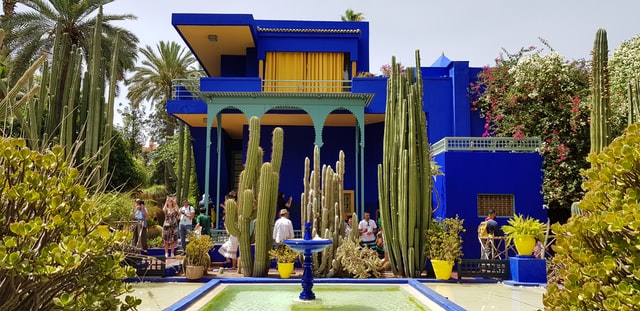
The Majorelle Garden
A small paradise, the Majorelle garden bears the name of its creator, Jacques Majorelle. A French painter, he moved to Marrakech in 1919 to pursue his career. Son of the famous cabinetmaker who produced some masterpieces of Art Nouveau in Nancy, Jacques Majorelle, painter put his talents to the service of urban planning in Marrakech….
A small paradise, the Majorelle garden bears the name of its creator, Jacques Majorelle. A French painter, he moved to Marrakech in 1919 to pursue his career.
Son of the famous cabinetmaker who produced some masterpieces of Art Nouveau in Nancy, Jacques Majorelle, painter put his talents to the service of urban planning in Marrakech. He participated in the new branch of orientalism encouraged during the 1920s. He built his studio and his house in the city, where he settled near the compound. Around the two poles of his universe, he created a heavenly garden. He gathered all sorts of exotic species from all over the world. Bought by Pierre Berge and Yves Saint Laurent, it was restored and opened to the public.
The construction of his garden of exotic plants took several years. A place of inspiration and rest, it was opened to the public in 1947.
Before you begin your stroll through the garden, you should know that it is home to five main categories of plants:
- cacti,
- palms,
- bamboos,
- flowering pots aquatic plants.
Jacques Majorelle had a particular interest in cacti.
Video
About thirty representatives of this family are currently to be discovered in this haven of peace. As for the palm trees, their abundance will give you the impression that you are in an oasis of calm. The collection gathered in the Majorelle garden includes species from California, East Africa, India, the Canaries, Mesopotamia and the Mediterranean basin.
The third category is bamboo. Native to Southeast Asia, you will certainly appreciate them for their decorative foliage and elegant habit. And that’s not all. Your stroll through the Majorelle garden is punctuated by dozens of flower pots in the colors of the garden.
Majorelle blue combines with lemon yellow, light green and sky blue. Aquatic plants with amazing colors complete the loop. They are welcomed by soothing basins, fountains and gutters.
The Majorelle garden is also an exceptional landscape and a beautiful collection of birds.
How to get to the Majorelle Garden
Open from Monday to Sunday: from 9am to 6pm last access at 5:30pm
Rue Yves St Laurent, Marrakech 40090, Morocco
https://www.jardinmajorelle.com/
https://goo.gl/maps/kN43tn9df8ZjdbRv5