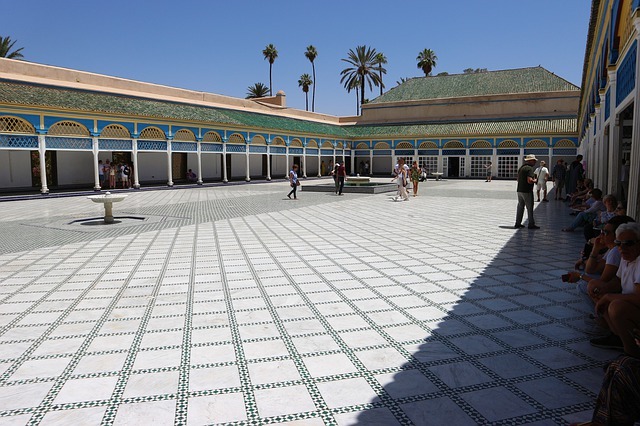

Medersa Ben Youssef
The palace “Dar El Bacha” is unknown to tourist guides. It is almost impossible to find its name in the usual books available to tourists and it is absolutely not in the program of the proposed guided tours. However, this jewel of city architecture is well worth the detour as it has nothing to envy…
The palace “Dar El Bacha” is unknown to tourist guides. It is almost impossible to find its name in the usual books available to tourists and it is absolutely not in the program of the proposed guided tours. However, this jewel of city architecture is well worth the detour as it has nothing to envy to the more famous Bahia Palace. Behind austere walls, “Dar El Bacha” near “Bab Doukkala” reveals itself to be a jewel of the “Pearl of the South”.
A sumptuous Koranic school where one can admire the beauty of Saâdian art with decorative motifs assembled to awaken all the senses: cedar wood from the Atlas Mountains, Carrara marble from Italy, zelliges (sculpted plasterwork), mosaics and stuccos made by the greatest craftsmen.
History
The Saâdian Sultan Abdellah Al Ghalib completed the construction of the Medersa Ben Youssef in 1564. It was a place of welcome for nearly four centuries, for all children wishing to study in all fields and especially theology.
This Koranic school had, at that time, a notoriety all over the world and the students (usually reaching 300 members and almost 1000 towards the end) came from everywhere to have a 6 years teaching in this place of prayer. On 1700 m2 (and built on two levels) one can see a hundred rooms, a huge patio, courtyards, a pool, a gallery, and a prayer room.
In 1962, the teaching place moved and the Medersa became a sumptuous place to visit where one can admire the beauty of Saâdian art with decorative motifs assembled to awaken all the senses. A multitude of decorations intermingle with harmony: cedar wood from the Atlas, marble from Carrara in Italy, zelliges (sculpted plaster) of different colors and shapes, mosaics and stuccos made by the greatest craftsmen.
The ablutions basin used for the purification of the body (“O believers! When you prepare to pray, wash your face and hands up to the elbow; wipe your head and feet up to the ankles. Sura V, verse 4.) in the center of the courtyard, is of great sobriety. In addition to the large bronze door and the sculpted beams, one can discover the plaster Mirhab (a niche in the wall of the Medersa. It indicates the direction of Mecca. The faithful therefore pray in its direction) where verses, inscriptions or epigraphs are engraved in honor of the founder. But our beautiful speeches can never replace the visit that you absolutely must make during your stay in Marrakech.
Video
How to get to the Medersa Ben Youssef
Open every day from 9am to 6pm. (closed for religious holidays) Admission: 20 dirhams.
Rue Assouel, Marrakech 40000, Morocco
https://goo.gl/maps/fdSqYicUG54k3HoJ8